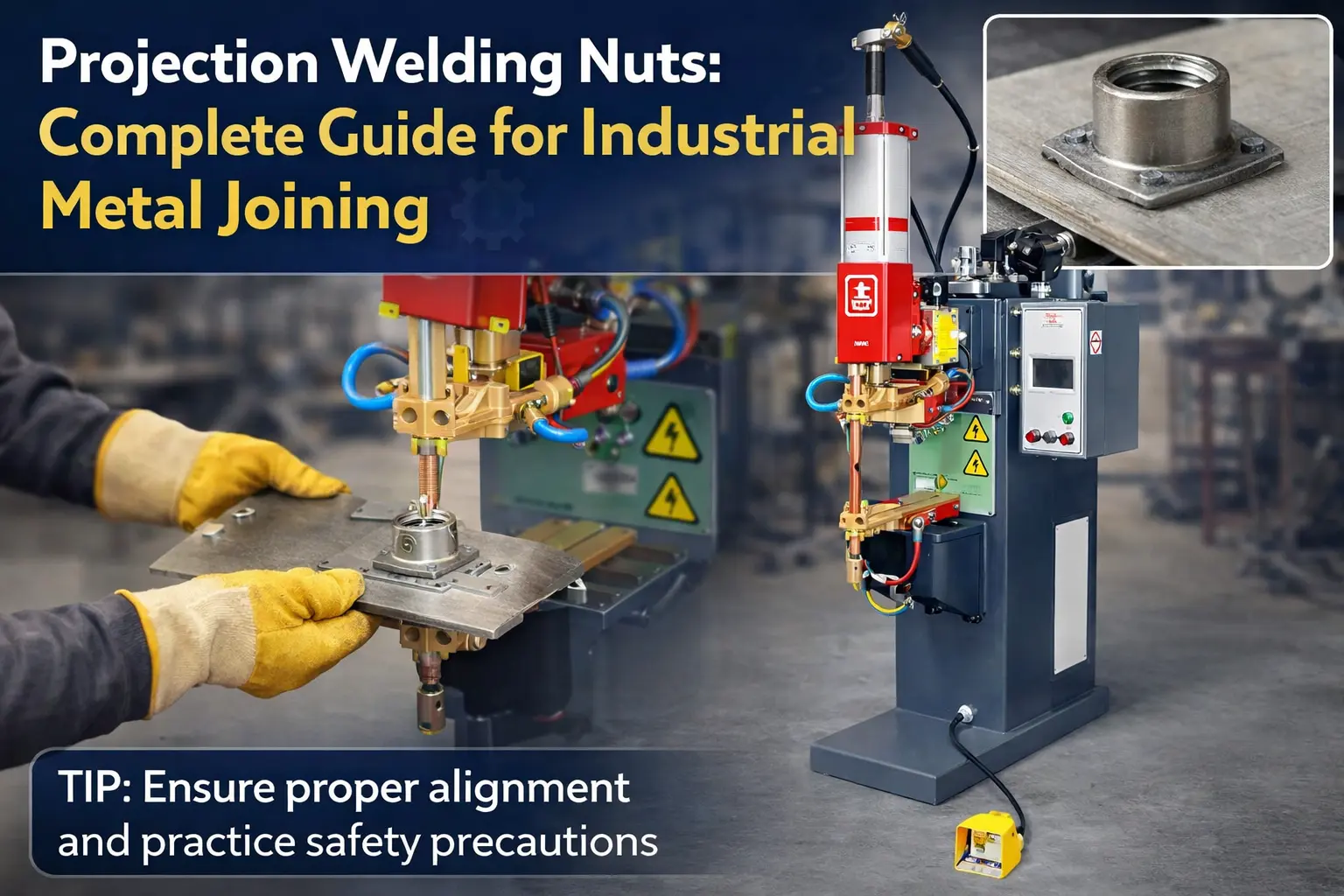
In modern manufacturing, achieving strong, reliable, and repeatable welds is critical for product quality and production efficiency. Among the range of resistance welding technologies, projection welding has become a trusted method for industries requiring precision, speed, and automation. For OEMs, factory decision-makers, and automation integrators, understanding the capabilities of a projection welder can streamline operations and reduce costs.
Heron Welder, a global leader in industrial welding solutions, provides advanced projection welding machines, controllers, and automated production lines that cater to diverse manufacturing needs.
What Is a Projection Welder?
Projection welding is a type of resistance welding where raised projections on one of the workpieces concentrate electrical current and pressure at predetermined points. When current passes through these projections, localized heating occurs, fusing the metals together precisely at these spots.
Unlike traditional spot welding, which relies on electrode positioning and can be sensitive to material inconsistencies, projection welding delivers consistent, high-quality welds with minimal operator intervention. This makes it ideal for high-volume production and automated manufacturing lines.
Key Principle:
- Current flows through the raised projections.
- Electrical resistance at each projection generates heat.
- Pressure applied by electrodes ensures uniform metal fusion at each joint.
Heron’s projection welders employ advanced controls to precisely regulate current, pressure, and timing, ensuring repeatable weld quality even on complex assemblies.
Common Applications of Projection Welding
Projection welding is highly versatile and widely used across industries where structural integrity and productivity matter:
Automotive Manufacturing
Projection welders are extensively used to assemble car body components, brackets, and battery terminals. They provide consistent weld strength while minimizing distortion on sensitive sheet metals.
Electrical and Electronics
From electrical connectors to battery packs, projection welding ensures reliable joints with minimal resistance, essential for conductivity and safety.
Heavy Equipment and Machinery
Industrial-grade assemblies, such as frames, brackets, and structural components, benefit from projection welding’s repeatable precision and high throughput.
Metal Fabrication and HVAC
Sheet metal assemblies, ducts, and enclosures can be welded efficiently without compromising surface finish, reducing post-weld finishing time.
Advantages of Projection Welding Over Spot Welding
While spot welding is common in many factories, projection welding offers distinct advantages for certain production environments:
- Repeatability: Raised projections define weld points, reducing operator error.
- Multiple Welds in One Cycle: Several projections can be welded simultaneously, increasing productivity.
- Less Electrode Wear: Focused heat at projections minimizes electrode degradation.
- Lower Material Distortion: Concentrated welds preserve the integrity of surrounding materials.
- Automation-Friendly: Ideal for integration into robotic and automated assembly lines.
Heron Welder’s machines are designed with robust electrode systems, MFDC controllers, and programmable automation options, ensuring consistent performance even in high-volume operations.
How to Choose the Right Projection Welder
Selecting the right projection welder involves evaluating:
- Material Type & Thickness: Aluminum, steel, and galvanized metals require different current settings and electrode configurations.
- Production Volume: High-volume production favors automated or multi-gun projection welders.
- Joint Design: The size and shape of projections influence electrode choice and machine parameters.
- Automation Requirements: Integration with conveyors, robotic arms, or automated inspection can enhance throughput and quality.
Heron offers customized projection welding solutions, from standalone machines to fully automated production lines, tailored to your factory’s requirements.
Best Practices for Projection Welding
Ensuring consistent, high-quality welds involves:
- Maintaining Electrode Condition: Regular inspection and replacement prevent inconsistent welds.
- Accurate Projection Design: Uniform projection height and spacing improve heat concentration.
- Proper Current and Timing Settings: Adjusting current, pressure, and weld time based on material ensures optimal fusion.
- Routine Machine Calibration: Scheduled maintenance keeps the welder performing reliably.
Heron’s technical support team provides training, installation guidance, and process optimization to help engineers maximize production efficiency.
FAQs About Projection Welders
Q1: Can projection welding be used on aluminum?
Yes. With appropriate MFDC current control and electrode design, aluminum projections can be welded efficiently without excessive distortion.
Q2: How does projection welding differ from spot welding?
Spot welding applies current at the electrode contact point, while projection welding concentrates current at predefined projections, allowing multiple joints in one cycle and improved repeatability.
Q3: Is projection welding suitable for automation?
Absolutely. Projection welders are highly compatible with robotic arms and automated production lines, enabling high-volume, precise manufacturing.
Q4: What maintenance is required for projection welders?
Electrodes should be inspected for wear, machine calibration performed regularly, and pneumatic or hydraulic systems checked to maintain optimal pressure.
Q5: Can projection welders handle complex assemblies?
Yes. Heron’s machines are capable of welding multi-layered and irregular geometries with precision and consistency.
Why Choose Heron for Projection Welding Solutions
Heron Welder is a trusted global manufacturer of industrial welding machines and automated metal-joining systems. Our expertise spans:
- Resistance Welding: Spot, projection, seam, MFDC, and capacitor discharge systems.
- Clinching & FSPR: Mechanical joining solutions for automotive and industrial applications.
- Welding Automation: Customizable production lines for high-volume, precise operations.
- Controllers & Accessories: Advanced MFDC and solid-state controllers for process stability.
With decades of engineering experience, Heron ensures that your projection welding solution is optimized for quality, efficiency, and ROI.
Take the Next Step in Precision Welding
Ready to enhance your manufacturing efficiency and weld quality? Request a quote or consult Heron’s technical team today to explore projection welding solutions customized for your factory or automation line. Our experts will guide you from machine selection to integration, ensuring your production goals are met with precision and reliability.

 English
 French
 Spanish
 Portuguese
 Deutsch
 Turkish
 Dutch
Dutch
 Italiano
 Russian
 Romaian
 Portuguese (Brazil)
 Greek
Greek
 Indonesia