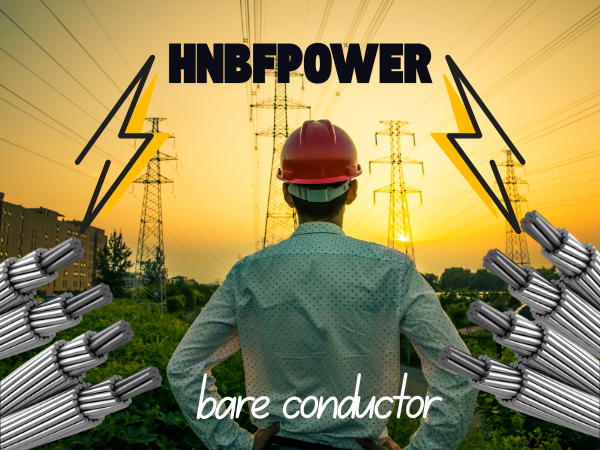
In power transmission and distribution, selecting the right conductor is foundational to system efficiency, reliability, and safety. Among the core components that engineers and procurement professionals must evaluate is the bare conductor a simple term that masks a complex set of performance, material, and application considerations. In this article, we demystify bare conductors, explore their key characteristics and applications, and show how HNBF Power delivers industry‑leading bare conductor solutions tailored to demanding utility and infrastructure projects.
What Is a Bare Conductor?
A bare conductor is an electrical conductor that is not covered with insulation. Instead, it relies on its own material properties typically aluminum or aluminum alloy to carry current through the air. These conductors are foundational in overhead power lines and serve as the backbone for long‑distance transmission and local distribution networks.
Bare conductors differ from insulated cables used in underground or indoor systems. Because they operate in open environments, their electrical, mechanical, and environmental performance specifications must be engineered to withstand exposure, temperature variations, mechanical stress, and electrical loading.
Key Types of Bare Conductors
Understanding the types of bare conductors is essential for making informed design and procurement decisions. Here are the most commonly used variants:
AAC (All‑Aluminum Conductor)
-
Composition: Solid aluminum.
-
Use Case: Low‑voltage distribution due to excellent conductivity and corrosion resistance.
-
Benefits: Lightweight, cost‑effective, and easy to install.
AAAC (All‑Aluminum Alloy Conductor)
-
Composition: High‑strength aluminum alloy for enhanced mechanical performance.
-
Use Case: Urban and rural networks where load and span requirements vary.
-
Benefits: Better strength‑to‑weight ratio compared to AAC.
ACSR (Aluminum Conductor Steel Reinforced)
-
Composition: Aluminum strands wrapped around a steel core.
-
Use Case: Long‑span transmission lines demanding high tensile strength.
-
Benefits: Combines conductivity of aluminum with tensile strength of steel.
ABC (Aluminum Conductor, Bare with Steel Strand)
-
Composition: Multiple aluminum strands and a galvanized steel core.
-
Use Case: Reinforced distribution lines in congested urban environments.
-
Benefits: Enhanced load, mechanical robustness, and reliability.
Each conductor type carries its own strengths and trade‑offs, and HNBF Power engineers can help you select the right bare conductor based on environmental conditions, mechanical loads, current capacity, and long‑term performance goals.
Why Bare Conductor Selection Matters
For utility engineers and procurement teams, a bare conductor isn’t just a commodity it’s an investment that influences system life cycle costs, safety compliance, and operational reliability.
1. Electrical Performance
Bare conductors must support consistent current flow with minimal resistive losses. Material purity and cross‑sectional design directly impact conductivity and efficiency.
2. Mechanical Strength
Weather factors like wind, ice loading, and thermal expansion exert stress on overhead lines. Conductors like ACSR and high‑strength AAAC are engineered to maintain integrity under heavy mechanical loads.
3. Corrosion Resistance
Exposure to rain, pollution, and salt spray can degrade conductors over time. Selecting the right alloy and protective specifications enhances service life.
4. Installation Efficiency
Lightweight, flexible conductors streamline installation schedules and reduce labor costs. For emergency restoration or rapid rollout projects, installation complexity is a key consideration.
By aligning conductor selection with system requirements, utilities can minimize failures, reduce maintenance costs, and maximize uptime.
How HNBF Power Engineers Bare Conductor Solutions
At HNBF Power, we understand the nuanced demands of modern power systems. Our bare conductor portfolio is engineered around global standards and optimized for performance, durability, and cost‑effectiveness.
Advanced Materials & Precision Manufacturing
We source high‑grade aluminum and steel to produce conductors that meet strict conductivity and mechanical specifications. Our manufacturing processes ensure uniformity, strand integrity, and long‑term reliability.
Customized Configurations
Not all networks are the same. Whether your project requires enhanced tensile strength for long spans or optimized conductivity for dense urban distribution, HNBF Power delivers tailored solutions including custom AAAC, AAC, ACSR, and ABC configurations matched to your design parameters.
Rigorous Quality Assurance
Each conductor is subjected to stringent testing, including tensile strength verification, electrical resistance measurement, elongation assessment, and surface quality inspections. These checks ensure conformity with international standards like IEC and ASTM.
Technical Support from Concept to Commissioning
Our technical team works closely with engineering and procurement stakeholders. From initial specification reviews to detailed product documentation and logistics planning, we support your needs at every stage.
Practical Applications of Bare Conductors
Bare conductors are indispensable across a range of power infrastructure systems:
-
High‑voltage transmission lines that connect generation to load centers.
-
Distribution networks for city and regional power delivery.
-
Rural electrification projects where long stretches require durable, cost‑effective conductors.
-
Industrial campuses with unique electrical infrastructure demands.
Because each application comes with distinct environmental and performance constraints, choosing the correct conductor type is an essential engineering decision.
FAQs About Bare Conductors
Q1: Why aren’t bare conductors insulated like underground cables?
A: Overhead systems rely on air as the dielectric medium, which naturally separates conductors from structures and ground. Insulation is unnecessary for air‑insulated lines and would incur additional cost, weight, and heat dissipation issues.
Q2: Can bare conductors handle high voltages?
A: Yes — when engineered correctly. High‑voltage transmission lines commonly use ACSR and similar bare conductors designed for elevated electrical and mechanical stresses.
Q3: How does temperature affect bare conductors?
A: Temperature changes impact conductor resistance and expansion. Materials and design must accommodate thermal cycling to avoid sagging and mechanical strain.
Q4: What standards govern bare conductor quality?
A: International standards such as IEC and ASTM define material, mechanical, and electrical criteria for conductors. HNBF Power adheres to these standards to ensure global compliance.
Q5: How do I choose between AAC, AAAC, and ACSR?
A: Selection depends on mechanical load, span distance, conductivity requirements, and environmental conditions. HNBF Power engineers can assess your parameters and recommend the optimal conductor type.
Conclusion
Selecting the right bare conductor is a strategic decision that affects performance, cost, and system longevity. With HNBF Power’s expertise in overhead conductors and customized cable solutions, you gain not only high‑quality materials but also technical insights that elevate your project’s success.
Ready to optimize your power transmission and distribution infrastructure? Contact HNBF Power today for tailored bare conductor solutions that meet your exact engineering and procurement requirements.

 Arabic
 French
 Spanish
 Portuguese
 Deutsch
 Turkish
 Dutch
Dutch
 Italiano
 Russian
 Romaian
 Portuguese (Brazil)
 Greek
Greek
 Indonesia