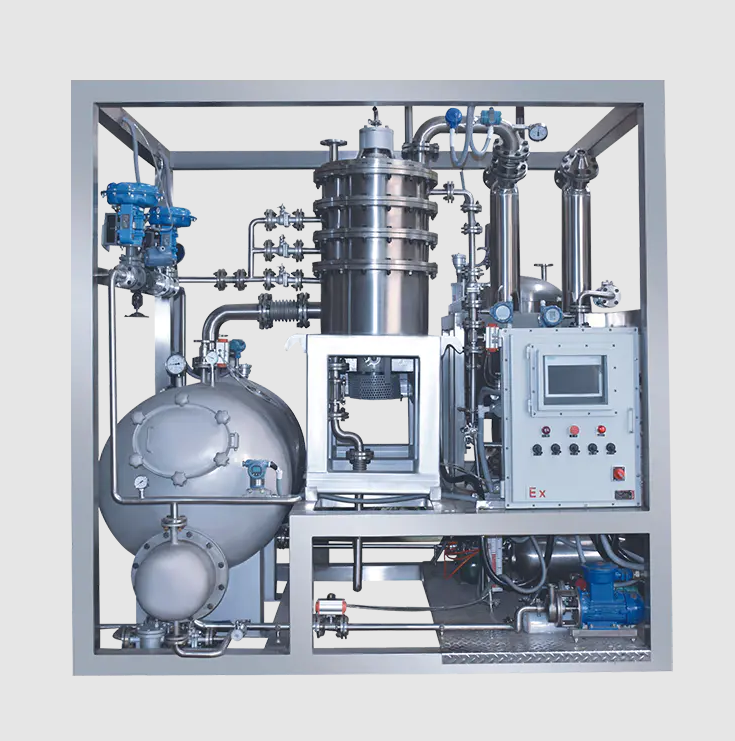
When engineers and technicians discuss Extraction Unit design on forums and technical Q&A sites, a number of recurring design considerations emerge. Unlike simple textbook examples, industrial extraction must account for complex feed compositions, phase behavior, and downstream requirements. One common topic is the trade-off between residence time and mass transfer efficiency. Longer residence times typically enhance solute transfer from feed to solvent, but also increase equipment footprint and capital cost. These trade-offs are discussed at length by designers who share practical sizing tips and criteria for selecting columns, mixers, or centrifugal contactors.
Solvent handling and recovery loops are another area people ask about. Extraction processes often require significant solvent volumes, which must be recovered and reused through separation steps. Many posts highlight how improper solvent regeneration can lead to buildup of impurities in recycled streams, reducing extraction efficiency and increasing operating costs. Users exchange strategies for solvent regeneration including phase separation designs, controlled decanting, and using supplementary equipment such as extractor-centrifuges to speed up phase disengagement.
Materials of construction are also frequently debated. Because extraction units deal with different solvents and feed chemistries, corrosion resistance and material compatibility become key design constraints. Stainless steels, specialized alloys, or lined vessels are often recommended in threads where users describe their plant experience with aggressive chemical streams.
A linked concern is regulatory and environmental compliance. Solvent emissions, effluent treatment, and worker exposure limits shape extraction design specifications, prompting discussions about vapor recovery units, closed-loop solvent handling systems, and hazard evaluations. Engineers exchange templates and checklists to ensure designs meet safety standards without requiring extensive redesign later.
Finally, those involved in start-ups or debottlenecking projects often ask whether to integrate extraction with downstream separation like distillation or membrane filtration. Combining an extraction column with a Distillation Unit can sometimes streamline the overall plant design but also complicates control strategies. The conversation often shifts to modeling tools and simulation software that can predict performance before construction, helping teams choose configurations with confidence.

 English
 Arabic
 Spanish
 Portuguese
 Deutsch
 Turkish
 Dutch
Dutch
 Italiano
 Russian
 Romaian
 Portuguese (Brazil)
 Greek
Greek
 Indonesia