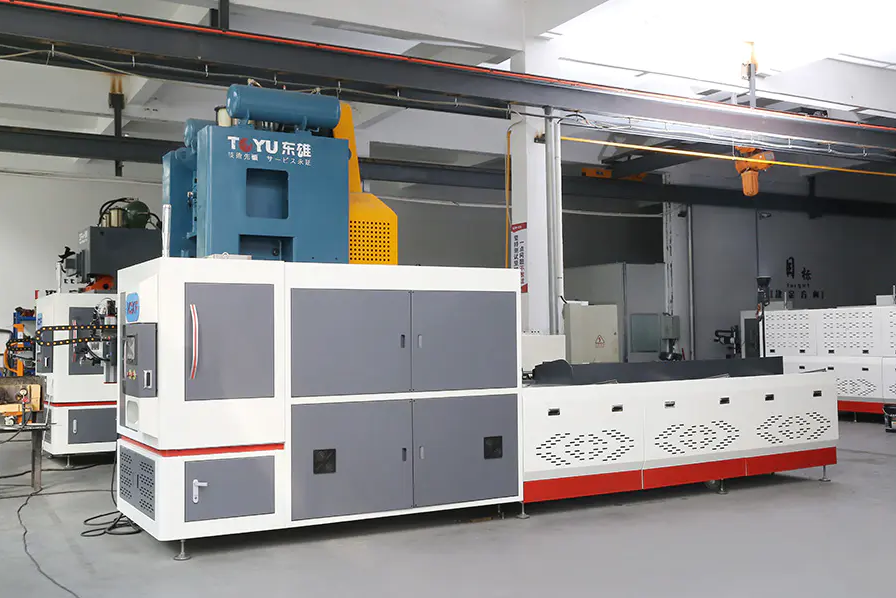
Manufacturers operating hot forging lines often encounter recurring issues that show up in search queries and posts on industrial forums. Whether it’s die wear, inconsistent part dimensions, or long cycle times, understanding the underlying causes is key to continuous improvement in manufacturing environments using Hot Forging Processing Technology.
One of the most frequently raised topics in discussions is temperature control. Since hot forging involves heating billets to above the recrystallization temperature of the metal — often well over 1000 °C for steels — maintaining uniform temperature across each workpiece is essential. Inconsistent heating leads to poor material flow and dimensional variation, which in turn increases scrap and rework. Automated heating systems equipped with sensors and feedback loops help achieve consistent temperature control across cycles, a common suggestion in industry conversations.
Die life is another operational challenge heavily discussed by practitioners. Dies must endure high pressures and repeated thermal cycling, which accelerates wear. Regular inspection, optimized die materials, and lubrication strategies are often recommended to extend service intervals and reduce downtime. Many professionals mention that forging lines with predictive maintenance systems can alert technicians to potential issues before they escalate into critical failures.
Material waste and trimming allowances often come up as cost-control concerns. Designers sometimes debate whether near-net-shape forging — which reduces excess material — is feasible for specific parts without compromising structural integrity. This balance between part accuracy and forging feasibility is a recurring theme in online engineering exchanges.
When transitioning from older machines to more advanced systems, many manufacturing teams ask whether to invest in customized equipment solutions. Customize Hot Forging Equipment is discussed as a strategic option where presses, handling systems, and dies are tailored to the specific load, throughput, and part complexity needs of a production line. Customization can include integrated induction heating, automated feeder systems, or temperature-monitoring modules to better support stringent production goals.
Worker safety and ergonomics also appear in many forum threads. Because hot forging involves high temperatures and heavy components, automated material handling not only improves consistency but also reduces operator exposure to hazards. Safety enclosures, interlock systems, and remote monitoring are practical measures shared by experienced operators.
Finally, software and data integration are becoming topics of interest. As digital technology becomes more accessible, manufacturers are exploring ways to use real-time data for process control, quality tracking, and predictive maintenance — moving away from reactive problem solving toward proactive management.
These common operational challenges are frequent subject matter for industrial professionals, reflecting the complex interplay between thermal metallurgy, machine mechanics, and production planning in hot forging environments.

 English
 Arabic
 Spanish
 Portuguese
 Deutsch
 Turkish
 Dutch
Dutch
 Italiano
 Russian
 Romaian
 Portuguese (Brazil)
 Greek
Greek
 Indonesia