If you’ve had the same tight spot in your neck, shoulder, or back for months (or years), you already know the routine. Stretch it. Massage it. Ignore it. Promise you’ll fix your posture. Repeat.
And yet… the knot is still there. Living rent-free in your muscle.
This is where Dry Needling Therapy enters the conversation. Not as a miracle cure. Not as medieval torture. But as a targeted treatment designed to address stubborn muscle knots that refuse to let go.
This guide explains how dry needling therapy works, why chronic knots form in the first place, and when this approach makes sense for people in Australia dealing with ongoing muscular pain.
🔍 Snapshot Summary: Dry Needling Therapy (At a Glance)
Short on time? Here’s the essentials.
-
Dry Needling Therapy targets trigger points and dysfunctional muscle tissue
-
It uses fine, sterile needles (no medication involved)
-
Designed to reduce chronic muscle tension and pain
-
Often effective when massage and stretching haven’t worked
-
Best used as part of a broader treatment approach
In simple terms, dry needling helps muscles reset, not just relax.
Want to know why those knots won’t disappear on their own? Keep reading.
What Are Chronic Muscle Knots (Really)?
Let’s clear something up.
That “knot” you feel isn’t actually a knot in the traditional sense.
It’s usually a trigger point. A small area of muscle that:
-
Remains in a contracted state
-
Has reduced blood flow
-
Becomes sensitive or painful when pressed
-
Can refer pain elsewhere
Bold truth:
Chronic muscle knots are less about flexibility and more about neuromuscular dysfunction.
They don’t disappear because the muscle has forgotten how to fully relax.
Why Muscle Knots Become Chronic
Muscle knots often start small and manageable. Then life happens.
Common contributors include:
-
Repetitive movements
-
Prolonged sitting or poor posture
-
Training overload
-
Old injuries
-
Stress and nervous system fatigue
Over time, the muscle adapts to constant demand by staying partially “on.” Eventually, that becomes its default state.
Stretching helps temporarily. Massage helps temporarily. But neither always tells the nervous system to stop guarding.
That’s where dry needling comes in.
What Is Dry Needling Therapy?
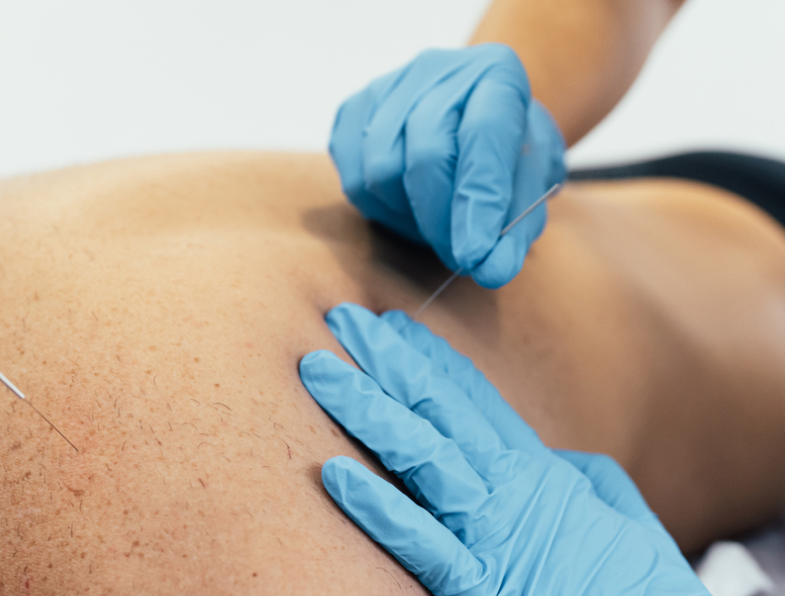
Dry Needling Therapy is a treatment that uses thin, sterile needles inserted directly into trigger points or dysfunctional muscle tissue.
There is:
-
No medication
-
No injection
-
No fluid (hence “dry”)
The goal is to:
-
Interrupt abnormal muscle firing
-
Reduce excessive muscle tone
-
Restore normal movement patterns
Important:
Dry needling is not acupuncture. It’s based on anatomy, muscle physiology, and pain science.
How Dry Needling Therapy Works
Dry needling works on both the muscle and the nervous system.
1. Trigger Point Deactivation
When the needle enters a trigger point, it can cause a brief muscle twitch. This is a good sign.
That twitch:
-
Resets the muscle’s firing pattern
-
Improves local blood flow
-
Reduces sensitivity
2. Nervous System Response
The needle provides a strong sensory input, which helps:
-
Reduce protective muscle guarding
-
Normalise muscle tone
-
Improve coordination
This is why relief often feels different from massage.
3. Improved Tissue Environment
Once tension decreases:
-
Circulation improves
-
Movement becomes easier
-
Load is distributed more evenly
Less strain means fewer recurring knots.
💡 Did You Know?
Many chronic knots return because the muscle is overprotecting due to past injury or overload, not because it’s “tight.”
Does Dry Needling Therapy Hurt?
This is the question everyone thinks but rarely asks directly.
The honest answer:
It can feel uncomfortable, but it’s usually brief and very tolerable.
Common sensations include:
-
A dull ache
-
A twitch
-
Temporary soreness after treatment
It’s not constant pain. It’s short, targeted discomfort with purpose.
And no, the needles are nothing like injection needles. Your muscles know the difference.
Dry Needling Therapy vs Massage
Both are useful. They just do different things.
Massage Therapy
-
Improves circulation
-
Relaxes tissue
-
Feels good immediately
Dry Needling Therapy
-
Targets deep trigger points
-
Alters muscle activation
-
Creates longer-lasting change
Massage calms muscles. Dry needling helps them reset.
Who Is Dry Needling Therapy Best For?
Dry needling is often recommended for people with:
-
Chronic neck or shoulder tension
-
Recurrent lower back pain
-
Persistent hip or glute tightness
-
Sports-related muscle overload
-
Pain that returns quickly after massage
If you’ve tried “everything” and the knot still wins, this approach may be worth considering.
Common Myths About Dry Needling Therapy
“It’s the same as acupuncture.”
It isn’t. Different philosophy, different goal.
“More needles = better results.”
No. Precision matters more than quantity.
“It fixes posture instantly.”
No treatment works alone. Dry needling supports change, it doesn’t replace movement.
Quick Guide: When Muscle Knots Just Won’t Let Go
The Situation
You’ve had the same tight spot for months. Sometimes it eases. It always returns.
Common Challenges
-
Does the knot come back days after treatment?
-
Does pain move or spread instead of resolving?
-
Do stretches feel ineffective or irritating?
How Dry Needling Therapy Helps
Direct Trigger Point Access
Reaches areas manual therapy can’t.
Muscle Reset Response
Interrupts chronic contraction patterns.
Improved Movement Tolerance
Allows muscles to relax during activity.
Supports Other Treatments
Enhances the effects of massage and exercise.
Why It Works
Because it addresses why the muscle stays tight, not just how it feels.
What Happens After a Dry Needling Session?
Most people notice:
-
Reduced tension
-
Increased range of motion
-
Temporary soreness similar to post-exercise fatigue
This usually settles within 24–48 hours.
Movement, hydration, and light activity help maximise results.
How Often Is Dry Needling Therapy Needed?
There’s no fixed rule.
Some people benefit from:
-
A few targeted sessions
-
Occasional maintenance during high workload periods
Others use it alongside ongoing manual therapy or rehabilitation.
Consistency beats intensity.
Quick Self-Assessment Quiz 🧠
Answer honestly.
1. Do you have muscle knots that return quickly after massage?
-
Yes
-
Sometimes
-
Rarely
2. Does your pain feel deep and hard to reach?
-
Yes
-
Occasionally
-
No
3. Have you tried stretching with little long-term success?
-
Yes
-
Somewhat
-
No
If you answered “yes” more than once, dry needling may be appropriate.
Safety and Qualifications Matter
Dry needling should always be performed by a trained and qualified practitioner.
Proper training ensures:
-
Correct needle placement
-
Safe technique
-
Appropriate clinical reasoning
Never be shy about asking about experience and credentials.
FAQs: Dry Needling Therapy
Is dry needling therapy safe?
Yes, when performed by trained professionals using sterile techniques.
How is dry needling different from acupuncture?
Dry needling targets muscle trigger points based on anatomy, not energy meridians.
Will one session fix everything?
Sometimes relief is quick. Often, improvement builds over a few sessions.
Can dry needling be combined with massage?
Yes. They often complement each other very well.
Is dry needling covered by health funds?
In some cases, when performed by eligible practitioners. Always check your policy.
Final Thoughts: Why Dry Needling Therapy Makes Sense for Chronic Knots
Chronic muscle knots aren’t stubborn because you’re doing something wrong. They’re stubborn because your nervous system has learned to protect certain areas a little too well.
Dry Needling Therapy offers a precise, effective way to interrupt that cycle. Not by forcing muscles to relax, but by giving them the signal they’ve been waiting for.
If knots keep coming back despite your best efforts, it’s not a failure. It’s feedback.
And sometimes, that feedback needs a needle. A very small one.

 Arabic
 French
 Spanish
 Portuguese
 Deutsch
 Turkish
 Dutch
Dutch
 Italiano
 Russian
 Romaian
 Portuguese (Brazil)
 Greek
Greek
 Indonesia