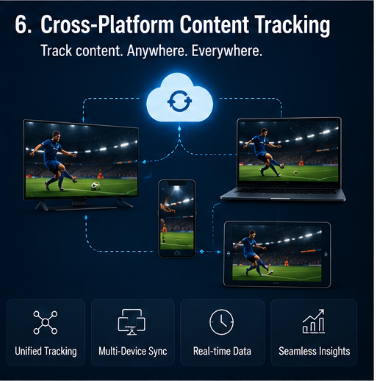
Today's viewers consume content everywhere—live television, time-shifted recordings, streaming services, social media clips, user-generated video, and more. Measuring total audience across this fragmented landscape has been a persistent challenge. Cross-Platform Content Tracking solves this problem by using consistent identification technology across all platforms. Whether content appears on a traditional television broadcast, a streaming service, or a social media clip, the same fingerprinting technology identifies it. The result is a unified view of viewership across platforms, enabling content owners and advertisers to understand total reach, frequency, and engagement.
This cross-platform unification is built on Audience Measurement and Media Analytics that aggregate data from diverse sources. A streaming service reports its viewing data. A smart TV reports broadcast viewing. A social media platform reports clip views. A set-top box reports time-shifted viewing. The measurement system combines these sources, deduplicating viewers who watched the same content on multiple platforms, and producing a single, comprehensive audience estimate. For content owners, this unified view reveals the true size of their audience. For advertisers, it reveals the true reach of their campaigns.
The Fragmentation Problem
Understanding cross-platform tracking begins with understanding the fragmentation that makes it necessary.
Platform Explosion
Two decades ago, most television viewing occurred on a few broadcast networks and cable channels. Today, viewers choose from hundreds of linear channels, dozens of streaming services, social media platforms, user-generated video sites, and more. Each platform has its own measurement approach, its own data formats, and its own reporting conventions. Combining data across platforms is technically challenging.
Viewing Fragmentation
Not only have platforms proliferated, but individual viewers now spread their attention across platforms. A single viewer might watch a live sports event on broadcast, a movie on a streaming service, and highlights on social media—all in the same evening. Measuring total content consumption requires tracking this individual across platforms, deduplicating counts when the same person views the same content in multiple places.
Measurement Fragmentation
Each platform historically used its own measurement methodology. Broadcast television used panel-based measurement. Streaming services used server logs. Social media used impression counts. These methodologies produced incompatible metrics, making cross-platform comparison impossible. A view on one platform might not be comparable to a view on another.
How Cross-Platform Content Tracking Works
Cross-platform content tracking uses consistent identification across all platforms, enabling data integration.
Unified Content Identification
The key insight of cross-platform tracking is using the same content identification technology across all platforms. Content is fingerprinted at the source, then every platform uses those same fingerprints to identify what is playing. A fingerprint created for a broadcast transmission is the same as one created for a streaming delivery or a social media upload. This consistency enables matching across platforms.

 English
 Arabic
 French
 Spanish
 Portuguese
 Turkish
 Dutch
Dutch
 Italiano
 Russian
 Romaian
 Portuguese (Brazil)
 Greek
Greek
 Indonesia