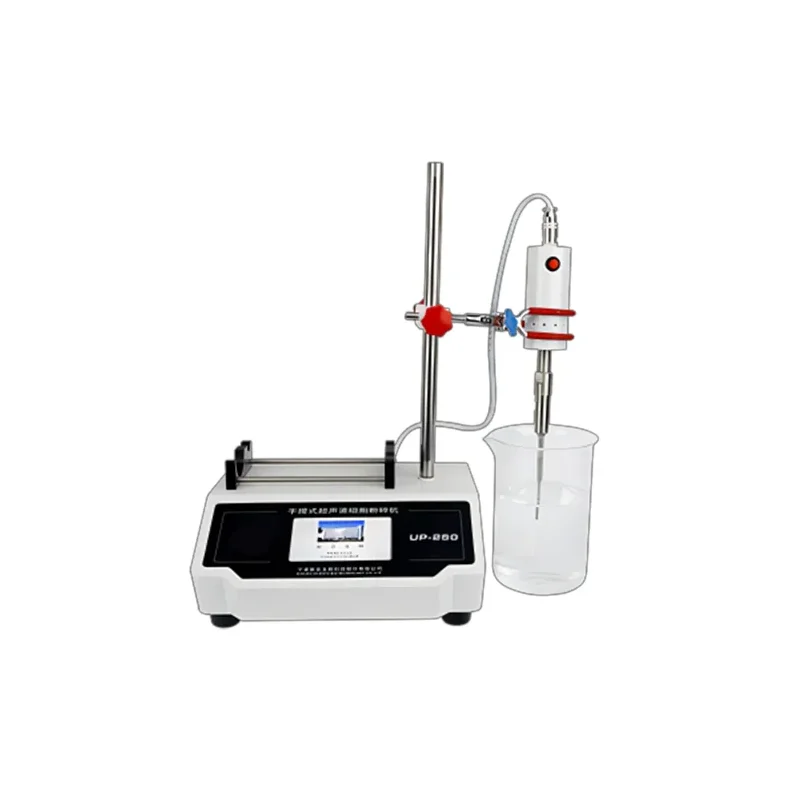
In contemporary biochemical, pharmaceutical, and materials laboratories, small-volume sample preparation demands both precision and repeatability. The Handheld Ultrasonic Homogenizer has emerged as a highly efficient solution for ultrasonic cell disruption and micro-scale dispersion tasks.
2026-02-26 11:43:21
In contemporary biochemical, pharmaceutical, and materials laboratories, small-volume sample preparation demands both precision and repeatability. The Handheld Ultrasonic Homogenizer has emerged as a highly efficient solution for ultrasonic cell disruption and micro-scale dispersion tasks.
Unlike conventional bench-top ultrasonic systems, a handheld ultrasonic homogenizer integrates portability with programmable control. The instrument adopts an LED display interface and supports automatic and manual (pedal-controlled) working modes. Ultrasonic time and power can be set arbitrarily, while sample temperature detection and frequency automatic tracking ensure operational stability.
Shanghai Zhenxin Technology Co., Ltd. has developed advanced handheld ultrasonic homogenizer systems that combine ergonomic design with high-frequency stability, delivering consistent performance for small-volume biological and chemical samples.
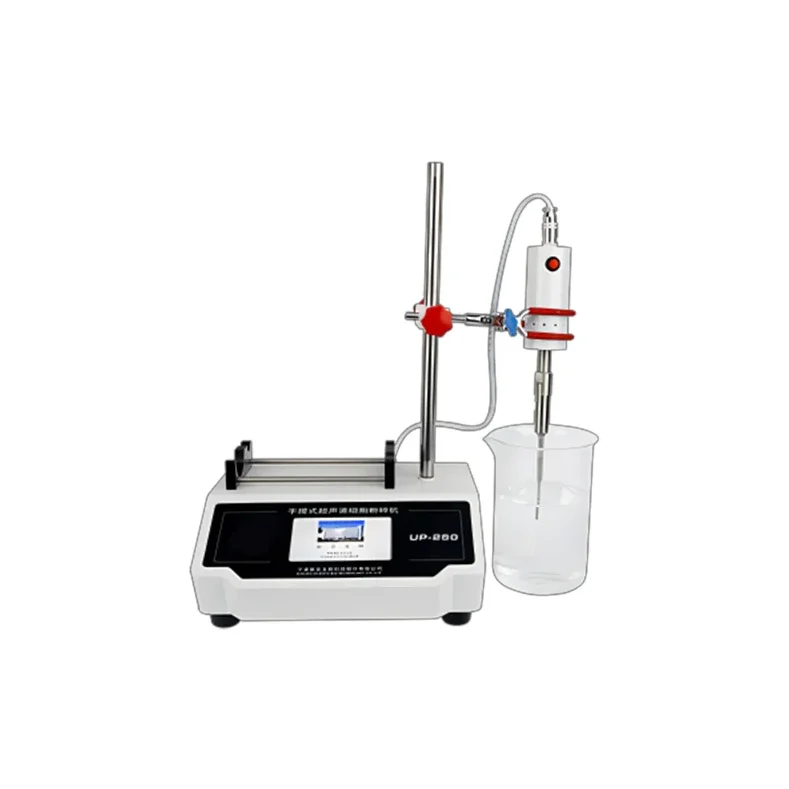
Fundamental Operating Principle: Ultrasonic Cavitation Dynamics
At its core, a handheld ultrasonic homogenizer operates based on the phenomenon of acoustic cavitation. When ultrasonic waves—typically in the 20–40 kHz range—are transmitted into liquid media, alternating high-pressure and low-pressure cycles generate microscopic vapor bubbles. These bubbles expand and collapse violently, producing localized shock waves and shear forces.
This cavitation effect enables:
-
Cellular membrane rupture
-
DNA and RNA extraction
-
Protein release
-
Nanoparticle dispersion
-
Emulsion formation
-
Degassing of solutions
For small sample volumes, precise energy delivery is critical. Excessive energy may cause thermal degradation, while insufficient energy compromises disruption efficiency. Frequency automatic tracking technology ensures that the transducer continuously adjusts to maintain optimal resonance conditions, even as sample viscosity or temperature changes.
Intelligent Control Architecture: LED Display and Dual Working Modes
Modern handheld ultrasonic homogenizers emphasize intuitive control systems. The LED display interface provides real-time visualization of:
-
Ultrasonic time
-
Output power
-
Sample temperature
-
Operating frequency status
Users can switch between two primary working modes:
1. Automatic Mode
Programmable cycles allow the operator to pre-set ultrasonic time and power. This mode ensures reproducibility, which is essential for regulated laboratory environments and standardized protocols.
2. Manual (Pedal) Mode
Foot pedal activation offers immediate control, allowing dynamic adjustment during sensitive procedures. This is particularly beneficial when processing delicate biological samples where visual cues determine disruption endpoints.
Shanghai Zhenxin Technology Co., Ltd. integrates responsive digital control modules that ensure stable amplitude output and prevent energy fluctuation during extended sonication cycles.
Temperature Monitoring and Thermal Management
One of the primary challenges in ultrasonic cell disruption is heat generation. Cavitation-induced friction raises sample temperature rapidly, potentially denaturing proteins or degrading thermally sensitive biomolecules.
A high-quality handheld ultrasonic homogenizer incorporates:
-
Real-time sample temperature detection
-
Temperature display feedback
-
Optional external cooling compatibility
By monitoring temperature continuously, operators can apply pulse sonication or ice bath cooling strategies to maintain sample integrity.
Shanghai Zhenxin Technology Co., Ltd. designs systems with precise temperature feedback sensors to safeguard sensitive experimental conditions.
Application Scope: Small Volume, High Precision
The handheld ultrasonic homogenizer is specifically engineered for small-volume sample processing, typically ranging from microliters to several tens of milliliters. Its applications span multiple scientific and industrial sectors:
Molecular Biology and Biotechnology
-
Bacterial and yeast cell lysis
-
Mammalian cell disruption
-
Chromatin shearing
-
Plasmid extraction
Pharmaceutical Research
-
Liposome preparation
-
Drug nano-emulsification
-
Active ingredient dispersion
Nanotechnology and Materials Science
-
Carbon nanotube dispersion
-
Graphene exfoliation
-
Metal nanoparticle suspension
Food and Environmental Testing
-
Microbial sample preparation
-
Enzyme extraction
-
Trace compound analysis
Due to its portability, the handheld ultrasonic homogenizer is also suitable for field sampling scenarios where laboratory-scale equipment is impractical.
Advantages Over Conventional Homogenization Methods
Compared to mechanical homogenizers or rotor-stator systems, ultrasonic homogenizers offer several measurable advantages:
-
No moving mechanical parts in contact with the sample
-
Reduced cross-contamination risk
-
Higher shear force intensity
-
Faster processing times
-
Enhanced uniformity in nanoparticle dispersion
Furthermore, handheld systems provide operational flexibility without sacrificing performance precision. Laboratories with limited space benefit from compact integration without compromising technical capability.
Safety and Operational Best Practices
To maintain consistent results and protect both samples and operators, adherence to best practices is essential:
-
Avoid dry running of the probe
-
Use appropriate personal protective equipment
-
Employ intermittent pulsing for heat-sensitive samples
-
Calibrate power settings according to volume size
-
Clean probes thoroughly to prevent contamination
Shanghai Zhenxin Technology Co., Ltd. recommends standardized operating protocols to ensure repeatable and safe ultrasonic processing outcomes.
Why Choose Shanghai Zhenxin Technology Co., Ltd.
Shanghai Zhenxin Technology Co., Ltd. combines precision electronic control, durable mechanical design, and intelligent user interface development in its handheld ultrasonic homogenizer systems. The company prioritizes:
-
Stable ultrasonic amplitude output
-
Accurate digital parameter setting
-
Reliable frequency auto-tracking
-
Compact ergonomic design
-
Laboratory-grade build quality
By integrating modern control algorithms with robust hardware engineering, Shanghai Zhenxin Technology Co., Ltd. delivers instruments suited for research institutions, pharmaceutical laboratories, and advanced material science facilities.
Conclusion: Compact Sonication with Advanced Control
The handheld ultrasonic homogenizer represents a convergence of portability and precision. With LED display control, programmable ultrasonic time and power, temperature detection display, automatic frequency tracking, and dual working modes, it addresses the specific needs of small-volume ultrasonic cell disruption.
For laboratories seeking efficient, repeatable, and safe micro-scale homogenization, Shanghai Zhenxin Technology Co., Ltd. provides technologically advanced solutions designed to meet rigorous scientific standards.

 Arabic
 French
 Spanish
 Portuguese
 Deutsch
 Turkish
 Dutch
Dutch
 Italiano
 Russian
 Romaian
 Portuguese (Brazil)
 Greek
Greek
 Indonesia