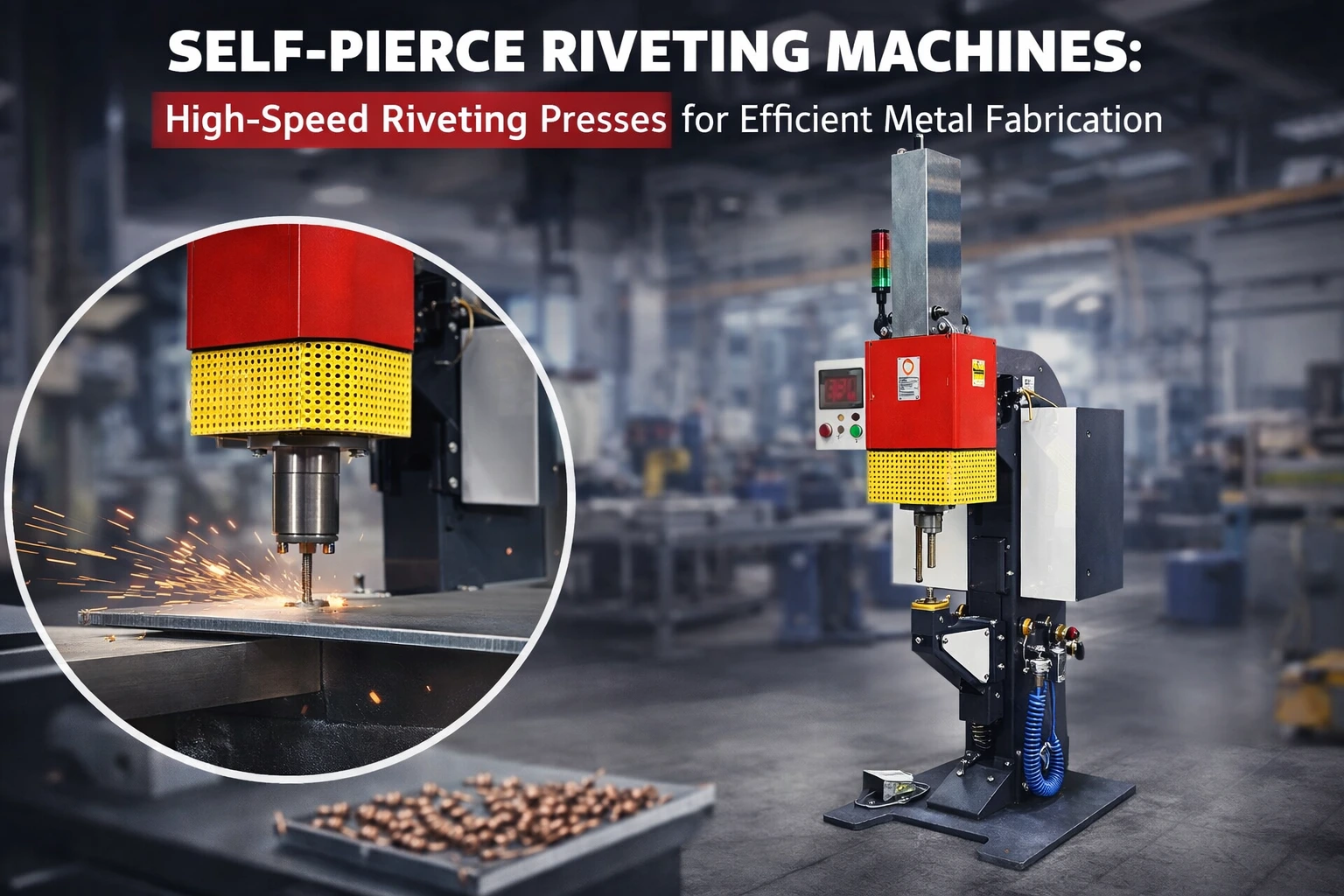
In today’s fast-paced manufacturing environment, achieving strong, reliable, and efficient metal joining is critical for OEMs, industrial fabricators, and automation integrators. Among modern joining technologies, self pierce riveting (FSPR) has emerged as a versatile, high-speed solution for joining dissimilar metals, aluminum, and coated steel sheets without pre-drilled holes.
At Heron Welder, we provide cutting-edge self pierce riveting systems designed to streamline production, improve joint quality, and integrate seamlessly with automated assembly lines.
What is Self Pierce Riveting?
Self pierce riveting is a mechanical fastening technique that joins two or more metal sheets by driving a semi-tubular rivet through the top layer(s) and flaring it into the bottom sheet without penetrating it entirely. Unlike traditional welding, FSPR avoids melting the base materials, making it ideal for joining metals with different properties or heat-sensitive coatings.
Key principles of FSPR include:
-
Rivet piercing: A specially designed rivet penetrates the upper sheet(s) using high-force mechanical pressing.
-
Material deformation: The rivet flares into the lower sheet, creating a tight, interlocked joint.
-
No pre-drilling required: The process eliminates the need for hole preparation, reducing production steps and cycle time.
Applications of Self Pierce Riveting
FSPR has gained widespread adoption across various industries due to its versatility and high-quality results. Some typical applications include:
Automotive Manufacturing
Self pierce riveting is extensively used in the automotive sector to join lightweight aluminum panels, coated steel, and hybrid material assemblies. By combining dissimilar metals without compromising structural integrity, OEMs can reduce vehicle weight, improve fuel efficiency, and maintain safety standards.
Aerospace and Aviation
In aerospace manufacturing, FSPR enables the joining of aluminum and composite sheets for aircraft interiors and fuselage panels, where precision and reliability are crucial.
Electronics and Appliances
Consumer electronics, home appliances, and HVAC units often require precise, durable joining of thin sheet metals. Self pierce riveting provides consistent results without damaging delicate coatings or components.
Construction and Industrial Equipment
FSPR is used in assembling metal frames, panels, and structural components where traditional welding could create distortions or weaken coatings.
Advantages Over Traditional Joining Methods
Compared with conventional welding and mechanical fastening, self pierce riveting offers several advantages:
-
Heat-Free Joining
Unlike MIG, TIG, or spot welding, FSPR does not require high temperatures, minimizing distortion and preserving surface coatings. -
Dissimilar Material Compatibility
FSPR can reliably join metals with different thicknesses, alloys, or coatings, making it ideal for aluminum-steel or coated sheet assemblies. -
High-Speed Production
Automated FSPR systems can achieve cycle times of under 1 second per joint, significantly boosting production efficiency. -
Consistent Quality and Strength
Controlled riveting force ensures uniform joint strength, reducing rework and scrap rates. -
Environmental Benefits
Since it eliminates the need for welding fumes, shielding gases, or secondary finishing, FSPR supports greener manufacturing practices.
Best Practices for Self Pierce Riveting
To maximize the benefits of FSPR, manufacturers should follow several key practices:
Material Selection and Thickness
Select rivets and equipment compatible with the specific sheet metal types and thicknesses. Heron’s FSPR systems support a wide range of materials, from thin-gauge aluminum to coated steel.
Rivet Quality and Tooling
Using high-quality rivets and properly maintained tooling ensures consistent joint strength and prevents rivet deformation or misalignment.
Integration with Automation
For high-volume production, integrating FSPR with automated conveyors, robotic arms, and quality inspection systems improves efficiency and reduces labor costs.
Process Monitoring
Regular monitoring of riveting force, cycle times, and joint integrity helps maintain product quality and reduce downtime. Heron offers advanced controllers for real-time process feedback and analytics.
Heron Welder: Expert Self Pierce Riveting Solutions
At Heron Welder, we design and manufacture industrial self pierce riveting systems tailored to your production needs. Our solutions include:
-
Fully automated FSPR production lines for high-volume applications.
-
Modular riveting cells that integrate with existing assembly lines.
-
Advanced controllers and tooling for consistent, reliable joints.
-
Consulting and technical support to optimize your joining process.
With decades of experience in industrial metal-joining technology, Heron is committed to helping manufacturers achieve superior quality, efficiency, and flexibility in their operations.
Self Pierce Riveting vs. Spot Welding: A Quick Comparison
| Feature | Self Pierce Riveting (FSPR) | Spot Welding |
|---|---|---|
| Heat Requirement | None (cold process) | High heat (resistance welding) |
| Material Compatibility | Dissimilar metals, coatings | Primarily similar metals |
| Joint Strength Consistency | High | Variable (depends on weld) |
| Cycle Time | 0.5–1 sec per joint | 1–3 sec per weld |
| Surface Distortion | Minimal | Possible warping/distortion |
| Coating Preservation | Excellent | Can be damaged |
This comparison highlights why FSPR is often preferred for lightweight, coated, or hybrid assemblies in modern manufacturing.
Frequently Asked Questions (FAQs)
1. Can self pierce riveting join aluminum to steel?
Yes. FSPR is ideal for joining dissimilar metals like aluminum and steel without compromising joint strength or surface coatings.
2. Is pre-drilling necessary for FSPR?
No. Self pierce riveting penetrates the top sheet(s) without pre-drilled holes, saving time and reducing production steps.
3. What thickness range can FSPR handle?
Heron systems accommodate a wide range of sheet thicknesses, from thin-gauge aluminum panels to thicker steel sheets.
4. Can FSPR be automated for high-volume production?
Absolutely. Automated FSPR cells integrate with robotic arms and conveyors for fast, consistent, and efficient production.
5. How does FSPR impact material distortion?
Since it is a cold mechanical process, FSPR minimizes distortion, preserves coatings, and maintains surface integrity.
Conclusion
Self pierce riveting is a reliable, efficient, and versatile joining technology that empowers manufacturers to produce high-quality assemblies with speed and precision. Whether your operation involves automotive, aerospace, electronics, or industrial equipment, FSPR provides a solution for joining dissimilar metals without heat damage or surface distortion.
Heron Welder offers customized self pierce riveting systems, expert consultation, and end-to-end support to help your factory optimize production, reduce costs, and maintain superior quality.
Request a quote or consult Heron today to explore how our self pierce riveting solutions can transform your metal-joining processes.

 English
 French
 Spanish
 Portuguese
 Deutsch
 Turkish
 Dutch
Dutch
 Italiano
 Russian
 Romaian
 Portuguese (Brazil)
 Greek
Greek
 Indonesia